
“The Dreams We Shared”
Your old men shall dream dreams and your young men shall see visions (Joel 2:28)
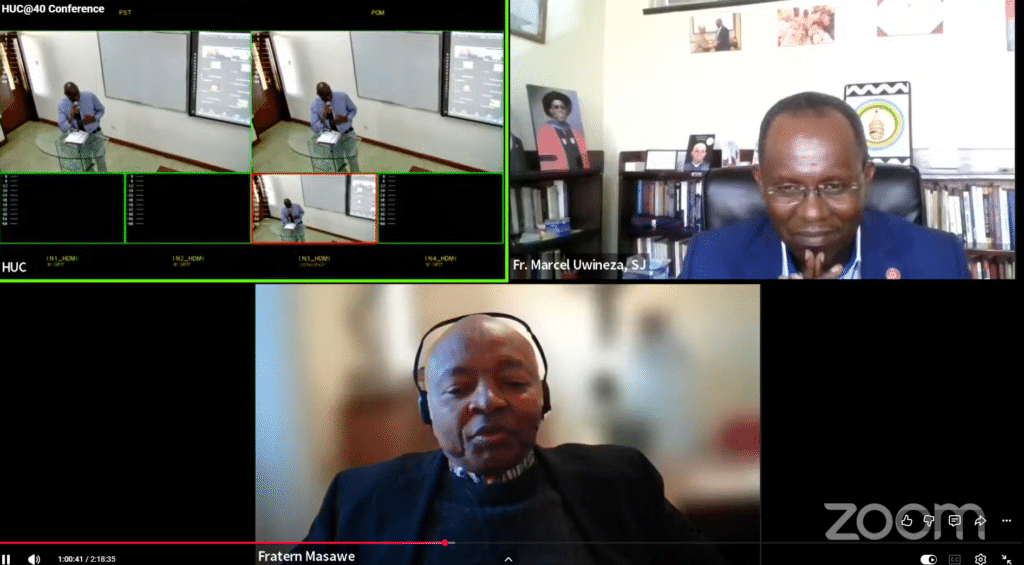
I would like to first acknowledge Fr. Deogratias Rwezaura, the Rector of the Jesuit Community at Hekima College, and Fr. Emmanuel Foro, the incoming Rector of the Jesuit Community at Hekima University College, Fr. Marcel Uwineza, the Principal of Hekima, Bishop Rodrigo Mejia, and Fr. Michel Istas, participating alumni, distinguished friends, ladies and gentlemen in the presence, and those of us in cyberspace. I should thank Fr. Jean-Luc Enyegue and your organizing colleagues for the space you have given me to address you on the 40th anniversary of Hekima University College, and to recall the dreams we shared then. This honour comes from the great respect I have developed over the years for the First Jesuit School of Theology in Africa, as well as the tremendous spiritual and material service it has provided to many of our people, for which we all remain most grateful. And I know there is a 40-year-old part of Hekima College in me, as I am an alumnus and one of the eyewitnesses of the wonderful testimonies of the opening of the first academic year on the 29th day of September of the year of our Lord, 1984.
Perhaps we should just take a minute to remember some of those witnesses who have since returned to the Lord.
- Lelo di Khuabi (ACE) died on 10/05/1992
- Henri De Decker (ACE) died on 11/09/1995 at 68 years of age
- Cecil McGarry (HIB) Dean died on 24/11/2009
- Raymond Moloney (HIB) Professor of theology died on 26/102017
- Victor Luke Odhiambo (AOR) died on 15/11/2018
- Fedele Dollo (AOC) died on 21/01/2021
- Antoine Venkalapati (EOF) died on 05/07/2022
Dreams of our elder brothers
The spiritual celebration of the 29th of September, 1984, was an actualization of a dream that went back to Easter of 1970, when a number of the Jesuits, in formation studying in Europe, some of them from Africa and Madagascar, and some missionaries from Europe who had done some years of regency in Africa, met in Louvain, in Belgium. They deliberated on sending a request, of course, to their respective major superiors in Africa to establish a Jesuit school of theology with an African character, which would prepare future Jesuit priests for better ministry in Africa.
The dream of the Louvain meeting percolated and went through different phases. It floated around for several years, over 14 years. Discussions included meetings of major superiors (JESAM) in Kinshasa, Douala, Ibadan, Lusaka, and Nairobi. And it even had some localization in Kimwenza in Zaire and in Ibadan one in Nigeria. None of these places proved to be feasible in the long term. Ibadan was a dream for several years, but it was eventually abandoned in 1976. It was then said that each unity would work in its own way to provide theological formation for its own scholastics. Obviously, it was not easy to bridge the gaps between the jurisdictions, mainly due to the colonial past, different educational systems, cultures, and languages, which tended to divide Africa and, unfortunately, even the Jesuits in Africa.
Nonetheless, the four main tentacles emerged from the dream:
- A call for a more universal and better inculturated formation program, thanks to the then Superior General, Fr. Pedro Arrupe, the servant of God, for his conviction, wise guidance and encouragement.
- In May 1981, in Villa Cavaletti, in Italy, the decision was taken by the major superiors of the Jesuit Conference of Africa in Madagascar to open a bilingual theologate in Africa, in collaboration with the Association of Member Episcopal Conferences in East Africa, AMECEA. The Jesuit Assistance of Africa was to have its own theological center for the first time in history.
- The theological center was to prepare the students with a suitable university program adapted to the local needs and to integrate its efforts into existing movements of search for an African theology.
- And a call for availability for exchange and for collaboration with other religious congregations, men and women, in their desire for a good theological formation, which would be an eminent service to the local church, In other words, an African research center at the service of the church.
The Response was Stupendous
The hearty welcome in the Archdiocese of Nairobi by then-Cardinal Maurice Michael Otunga made Fr. Polycarp Toppo, SJ, then regional superior of Eastern Africa, work hard with a dream emanating from the steering committee.
The then steering committee was made up of Fr. Christopher Munzihirwa, SJ (Servant of God), Fr. Henry De Decker, SJ, and Fr. Polycarp Toppo, SJ.
The brief that they got was very simple (12:48)
- An accent on the integration of spiritual life studies/research, apostolate and community life.
- Stress on serious studies integrated with African culture and related to the social context of Africa and Madagascar today,
- A frugal lifestyle which would indicate an evangelical commitment to poverty and solidarity with the poor.
- A sense of shared responsibility by organizing the community into smaller groups, living together in several houses/hostels, and being in charge of their own budget.
That later on translated into what we see today as the five hostels. Dining facility, the chapel, the library block, administration, the lecture halls, and sports area. (13:39) This is what you actually see today on Joseph Kangethe campus, of course, with a few additional buildings.
The response to the brief was just incredible. The major superiors of JESAM, now JCAM, responded promptly and generously. Followed by the home provinces of the missionaries in the Assistancy. The Roman curia was not left behind in this enterprise. They provided the funds needed for this project of the growing part of the Society of Jesus.
The library is one of those miracles of solidarity. Father Eddie Murphy, the then librarian, would have a tale to tell. Responses first came from Jesuit houses in Chicago, Detroit, Belgium, and France, then from India, Indonesia, Japan, Korea, the Philippines, Zambia, and Zimbabwe. More than 20,000 volumes were donated to this new theologate.
By September 29, 1984, only a few buildings were actually ready. But the teaching staff and the students were ready to start, as the appointments were made well in advance and in accordance with the brief’s criteria. Note well the mixture: (Internationality is not to be taken for granted. Visible on the 29th of September 1984.
- Fr. Henri De Decker (ACE), Rector Designate, 16 September 1982, coming from Congo at that time, originally from Belgium.
- Fr. Cecil McGarry (HIB), Dean of Studies, coming from Ireland
- Fr. Eddie Murphy (ZAM), Librarian, from Zambia at that time; the province was Zambia.
- Fr. Tony D’Souza was the minister
- Fr. Joseph Liber was a scripture scholar
The staff
Cecil McGarry, Raymond Molony, and Edward Murphy from Ireland; Henri De Decker and Michel Istas from Belgium; Rodrigo Mejia from Colombia; Tony D’Souza from India; and Joseph Liber from Poland.
The theologians (Students)
- Lelo di Khuabi, Nzanzu Kapitula and Thuadi Ngoma from Zaire, currently Democratic Republic of Congo
- Victor Odhiambo and Fred Oguba from Kenya
- Joseph Atanga from Cameroon
- Fidele Dollo from the Central African Republic
- Gilbert Rakotoarimanana from Madagascar
- Antoine Venkalapati from Mauritius
- Richard Randall from Britain/Zimbabwe
- Fratern Masawe from Tanzania.
To accommodate the men and the program, Hostel 1 and the staff house were to be used for accommodation and dining; the TV room as a classroom facility, and Hostel 2 as a library. We were good to go, waiting for the completion of the new and other facilities.
Apart from the overwhelming response from the Universal Society of Jesus for personnel, staff and students, books and finances, the Hekima dream continued to spread out like a bushfire in different directions. With a hindsight, the Association of Sisterhood of Kenya (AOSK)’s formation needs were made known and responded to, but in a couple of years, the lecture room space in Hekima College was too small for their number. Hekima College could not contain the religious in formation.
Our dream: The choice of the name.
What is in a name? The choice of “Hekima” indicates our dream of contextualising theology and using the term that was “à la mode” at that time: inculturation. Hekima was a choice very much of the first batch of students in 1984, after the rector, Father Henry De Decker, of a happy memory, consulted us. Hekima is not only a Swahili word familiar to many of us in Kenya and many in other parts of Africa, but it also has roots in the Middle East and in the Hebrew language, khokhma… meaning capacity to use knowledge and lived experience to make good decisions and judgments.
For us, Hekima was the right name for our newly founded first Jesuit school of theology in Africa. It was intentional. It carried the dream, the vision and the praxis we had in mind then. We knew we needed the ability to use knowledge and our contextual experience, our theory and practice, for the good of Africa and indeed for the world. The kind of theology we had in mind would not be done outside its own context. Hekima is, for us, a school of divine wisdom, where we pursue a theology that places wisdom in the service of faith and the promotion of justice. The then rector of the community and principal of the college made it very clear to us from day one.
In the first year, as the idea of small communities was still in a state of flux, so was the construction of the main campus. The communities were real, with real people facing real challenges – language, food, the so-called Saba Saba Day Street violence. The idea of small communities was frequently revisited, and some were relocated on and off the main campus as we also wrestled with the issue of “the smell of the sheep.”
Although we were close to Guadalupe Parish and involved in all the activities, including sacramental ministries, we were also connected to Riruta Parish, especially its outstation of Kangemi. Cardinal Maurice Michael Otunga assigned it to us to provide an opportunity for pastoral insertion in the Catholic community of Nairobi. Hekima was to be permanently connected with what is now known as St. Joseph the Worker Parish in Kangemi.
Dreams of the future
Gratitude is part and parcel of our African cultures. Ingratitude is not African. I would be insensitive if I do not pay tribute at least to some of our eminent professors of African theology. We are talking about:
- Boka di Mpasi
- Eboussi Boulaga
- Benezet Bujo
- Ezequiel Gwambe
- Laurenti Magesa
- Hebga Meinrad
- Jesse Mugambi
- Engelbert Mveng and his artistic legacy of the celebrated “Hekima Christus”
- Charles Nyamiti
- Aywald Shorter
These shared their dreams with us through their writings and creativity. Some of the writers were among the visiting professors we had then.
What moved me most was not only what was going on in Africa then, such as the freedom struggles, but the following words on how we evaluate our dreams:
“As individuals, we tend to judge our success by external criteria, such as social position, influence, popularity, wealth, or level of education. These are, of course, important measures of success, and it’s understandable that many people try to get the best out of themselves on these counts. But other inner criteria are perhaps more important in judging a man or woman’s achievement. Honesty, sincerity, simplicity, humility, generosity, the absence of vanity, and the ability to serve others – qualities within the reach of all souls are the true foundations of our spiritual life. But this kind of success cannot be achieved without genuine introspection and an awareness of our strengths and weaknesses.”
Conclusion
With those gracious words of Nelson Mandela, which he wrote to his wife from prison at that time, I would like to conclude with a question asked by Gerard May in his book, The Dark Night of the Soul: Why do we feel so separate and behave so destructively if we are made of love, filled with love, and meant for love? The answer he gives is from John of the Cross and Teresa of Avila. There are two reasons, he says. First, we are asleep to the truth; we do not realize who we are and what we are for. Second, we misplace our love. We become attached to things other than God.
This resonates with the advice King David gave his son Solomon. “Be strong, and show yourself a man, and keep the charge of the Lord your God, walking in his ways and keeping his statutes, his commandments, his ordinances, and his testimonies.” The raison d’être of HUC makes sense.
Perhaps the greatest dream we shared is the one we did not talk about, the dream of presence. Being less than 20 companions from 13 different countries and nationalities across the globe, living under the same roof, is probably the greatest witness to the dream of the reign of God.
Now, we have among the passionate dreamers of Hekima College two servants of God, maybe three, but I’ll mention two who are members of this college of ours. Pedro Arrupe and Mzee Christopher Munzihirwa; they are praying for us. I’m confident Hekima University College will continue to stand the test of time and be a vivid dream of a world community.
Thank you, and God bless.
