
Hekima University College (HUC) Principal, Rev. Dr. Marcel Uwineza, SJ, has highlighted the institution’s diverse academic programmes and research initiatives as central to its mission of forming professionals and leaders capable of promoting peace, justice and social transformation in Africa. Speaking during the HUC Public Lecture on 11 September 2026 at Arrupe Amani Campus, Riara Road, under the theme “Investing in Peace Before, During and After Kenya’s General Election 2027,” Dr. Uwineza said HUC’s commitment to peacebuilding is embedded in its academic identity as a Jesuit institution of higher learning.
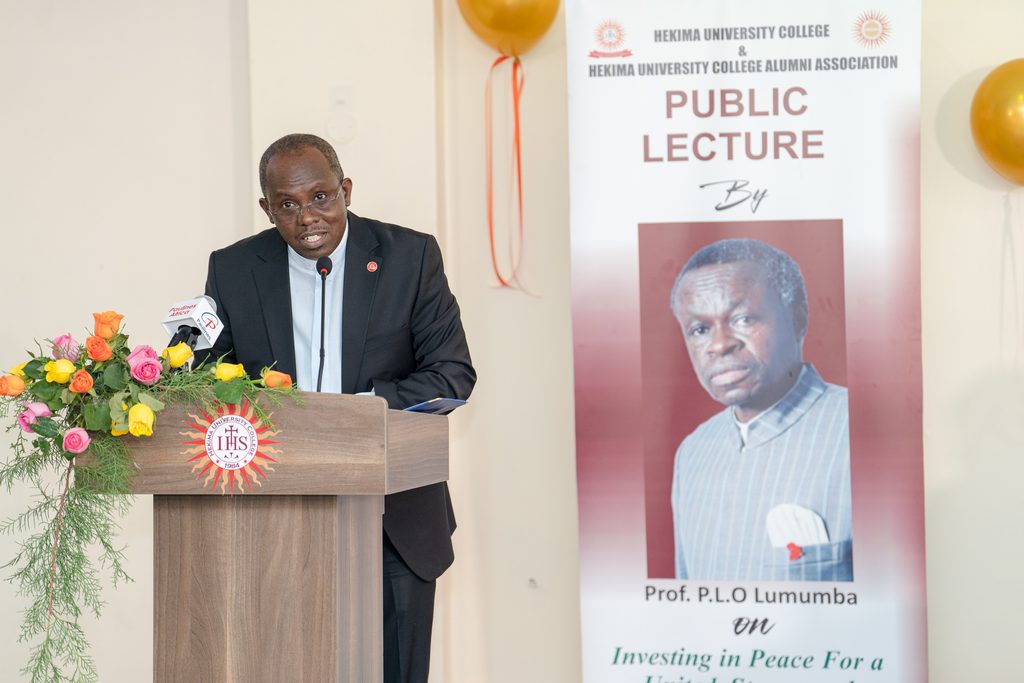
He explained that education at Hekima is intended to go beyond intellectual formation. “Education must do more than fill the mind. It must form women and men capable of transforming society,” he said, noting that HUC’s Jesuit heritage places particular emphasis on intellectual rigour, discernment, human dignity, character formation, compassion and service. The College educates both Jesuits and non-Jesuits, women and men, preparing them not only to understand the world but also to interpret its challenges and contribute to its transformation.
Among the programs he highlighted were Theology, Peace Studies & International Relations, Spirituality, Migration, Security & Diplomacy, Safeguarding, Interreligious Dialogue, Business Innovation and Social Entrepreneurship. The Principal explained that these programs respond to interconnected challenges facing African societies. In particular, HUC’s Peace Studies, International Relations, Migration, Diplomacy and Security programs enable the College to build a bridge between local peacebuilding and wider national, regional and international dynamics.
He observed that peace cannot be understood solely at the community level because decisions made by national governments, regional organizations, international institutions and global markets often have direct consequences for local communities. At the same time, he cautioned against studying international relations exclusively from the perspective of institutions and conference rooms while overlooking the experiences of people displaced by war, young people without opportunities, communities carrying historical grievances, migrants and communities affected by ecological devastation.
Fr. Uwineza identified teaching, research, publication and community service as four inseparable responsibilities of university life. He said the public lecture showed how these four dimensions come together in practice: HUC teaches about peace, researches the causes and dynamics of conflict, publishes its findings, and takes that knowledge beyond the university into society. “Knowledge must save society,” he emphasized, adding that a university cannot fulfil its mission if it produces knowledge while remaining indifferent to the wounds, struggles and aspirations of the society around it. The Principal thus positioned HUC’s academic programs not simply as courses of study but as instruments for responding to real social challenges and contributing to human flourishing.
Fr. Uwineza described HUC as a “laboratory of peace”, pointing to the College’s longstanding engagement in peace and conflict-related scholarship. Through its academic programs and the Center for Research, Training, and Publications, HUC has conducted research on conflicts and peacebuilding in Kenya, Ethiopia, Eastern Democratic Republic of Congo, and South Sudan. The College has also worked to develop and refine a conflict-monitoring tool aimed at informing policy.
This research, he noted, has not remained within academic circles. HUC researchers have engaged communities, religious leaders, women, youth, government officials, civil society organizations and embassies, creating opportunities for academic knowledge to inform practical peacebuilding. For Dr. Uwineza, this engagement demonstrates the distinctive role a university can play in society: generating knowledge, interpreting complex challenges and ensuring that research contributes to policy and social transformation.
The Principal further connected HUC’s academic mission to its commitment to justice. He argued that peace cannot be understood simply as the absence of demonstrations, violence, or political tension. “Peace is not silence. Peace is not fear. Peace is not the absence of demonstrations. Peace is the fruit of justice.” He stressed that HUC cannot promote peace without addressing the injustices that often generate conflict. This, he said, requires listening to young people, addressing legitimate grievances and challenging political and social practices that deepen division.
The 2027 Kenyan General Elections therefore provide an important opportunity for HUC’s academic programs, research and community engagement to contribute to a wider national conversation on peace, justice, leadership, democracy and social responsibility. Fr. Uwineza’s remarks presented HUC as an institution seeking to integrate academic excellence, research, professional formation and community engagement in response to Africa’s complex challenges. He concluded by welcoming Prof. PLO Lumumba, describing him as an appropriate voice to stimulate reflection on the Kenya the country wants to build before, during and after the 2027 General Election.
By Pamela Adinda, HUC Communications and International Office Coordinator
