
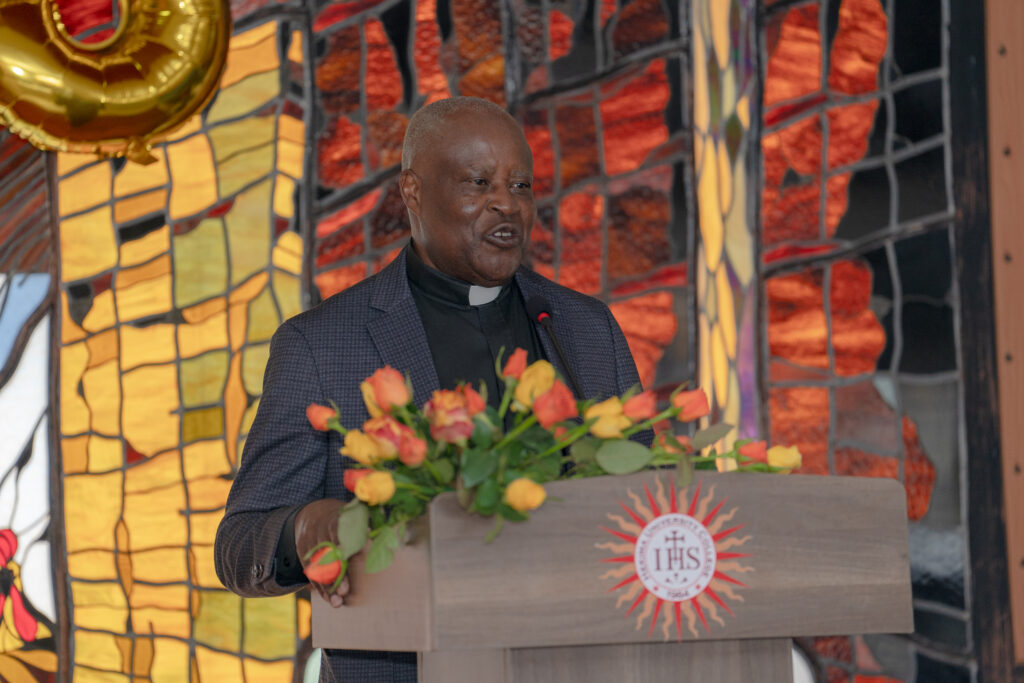
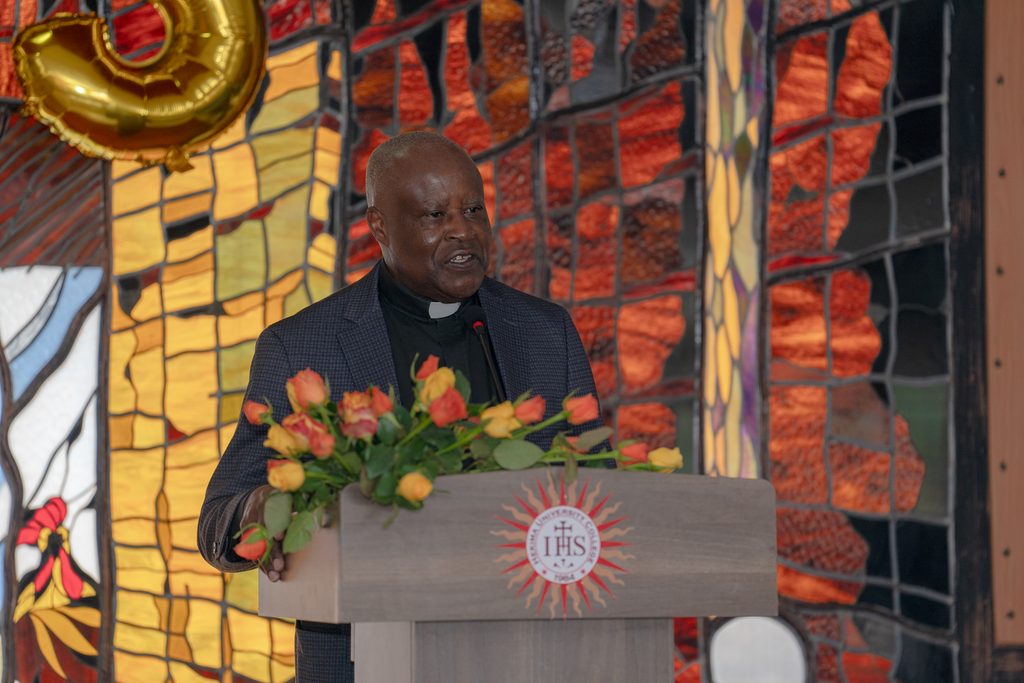
As Hekima University College (HUC) ushered in a new academic Year, HUC@43, (Academic Year 2026–2027) on August 15, Rev. Prof. Emmanuel Katongole, Ugandan Catholic priest, political theologian and professor at the University of Notre Dame, challenged the Hekima community to become more than an institution that transmits knowledge and calls it to reimagine the purpose of higher education and its responsibility to Africa. Delivering the keynote address at the inauguration, Prof Katongole called Hekima to become a “construction site” for a new society, another humanity, another system of production, another vision of politics and another imagination of life together.
Speaking on the theme “From Quick Fixes to Prophetic Interruption: On Daring to Reinvent the Future,” Prof. Katongole argued that the world is experiencing a profound “poly-crisis” in which multiple crises are unfolding simultaneously and reinforcing one another. Wars, political instability, climate change, economic inequality and the weakening of institutions, he said, point to a deeper crisis in the foundations of contemporary society. “We stand at a very, very critical time of history,” Prof. Katongole told the HUC community. He connected his reflection to the HUC@43 theme, Expanding Horizons, Empowering Futures, and asked a fundamental question: What kind of future are we building, and how should we build a new future in Africa?
A world where “the centre can no longer hold”
Prof. Katongole began his keynote by invoking the famous poem The Second Coming by Irish poet William Butler Yeats, written after the First World War. Yeats described a world in which “things fall apart” and “the center cannot hold.” For Katongole, those words remain strikingly relevant more than a century later. He pointed to conflicts in Gaza, Ukraine, the Democratic Republic of Congo and Sudan, as well as other conflicts around the world, as evidence of a world experiencing profound instability. He also highlighted rising global temperatures, political authoritarianism and growing institutional uncertainty.
The result, he said, is what contemporary thinkers have described as a “poly-crisis”, not one isolated crisis but multiple crises occurring simultaneously, reinforcing one another and threatening both the planet and the poor. Even institutions traditionally expected to provide stability and moral direction are themselves experiencing profound difficulties. “Things indeed fall apart,” he said. “The center can no longer hold.” For Katongole, however, the central challenge is not simply that crises exist. It is that society’s conventional responses to those crises often fail to question the assumptions and structures that produced them.
Beyond the politics of retreat and “catching up”
According to Prof. Katongole, two broad responses have emerged in the face of today’s crises. The first is a politics of retrenchment, a shrinking of the common political and moral space. It is characterized by slogans and approaches centered on “our” country, “our” nation, “our” tribe, “our” clan or “our” interests. In this approach, politics and even religion can become instruments for a limited group to pursue power and accumulation.
The second response, he said, is the desire to take advantage of the crisis to accelerate development and enable Africa to “catch up” with global powers. Africa is encouraged to become another major power centre, adopting existing models of liberal democracy, individualism and economic development. Although these approaches appear to be opposites, Katongole argued that they share a fundamental similarity: both rely on technical fixes without questioning the deeper imagination of power, self-interest, accumulation and domination.
The solutions may vary, expanding or dismantling institutions, increasing or reducing immigration, expanding or reducing fossil-fuel production, or redrawing political constituencies, but the underlying logic remains unchanged. “These responses do not really actually question the underlying story,” he said. Instead, they constitute what he described as a shrinking of the moral and political imagination.
“What we need is hope”
Katongole distinguished between optimism and hope. Optimism, he argued, assumes that the present system is essentially sound and that only minor adjustments are necessary. It trusts that things will eventually work out. Hope, by contrast, begins with an honest recognition that something is fundamentally wrong. “We shall not be fine, friends,” he warned. The world, he suggested, resembles a crumbling house whose foundations are no longer secure. The challenge, then, is not simply to rearrange the furniture or repair a few visible cracks.
“What we witness is the moral and spiritual bankruptcy of the house that we have built,” he said. The contemporary world, built around nation-state sovereignty, extractive capitalism and modern individualism, cannot simply be preserved through adjustments to existing structures. “Rearranging the furniture within this house will not do,” Katongole said. “The very foundations of the house are crumbling.” What is required, he argued, is not merely a new generation of technical experts, planners and administrators, but poets and prophets capable of imagining a different house and a different home.
Lament as a political act
At the center of Katongole’s keynote was the biblical concept of lament. Drawing especially on the prophet Jeremiah, he argued that lament should not be understood merely as private sorrow or religious consolation. Properly understood, lament is a deeply political task. He referred to Psalm 11:3: “When the foundations are destroyed, what can the righteous do?” For Katongole, this question captures the starting point for authentic hope. Hope begins not by denying the ruins but by honestly confronting them. “Hope and lament belong together,” he explained. “There is no hope without lament.”
Jeremiah, he argued, offers an important model for understanding the role of prophetic ministry in times of crisis. God’s call to Jeremiah contains two complementary tasks: “to pluck up and break down, to destroy and overthrow, and to build and plant.” These two tasks represent what Katongole described as critique and energizing. The prophet must first identify what is broken, unjust and destructive. But prophetic ministry cannot stop there. It must also energize people to imagine and construct something new. “Lament is the glue,” he said, connecting critique and energizing.
Jeremiah: prophet of critique and hope
Katongole presented Jeremiah as a figure whose prophetic ministry speaks directly to the contemporary world. Jeremiah lived during a period of political collapse in ancient Israel. As Jerusalem faced destruction and eventual exile, the prophet confronted a society numb to its own crisis. The people had eyes but could not see and ears but could not hear. Warnings alone were insufficient to awaken them. Jeremiah therefore became a “wailing prophet”, entering deeply into the suffering of his people.
Katongole identified four dimensions of Jeremiah’s lament. First, lament becomes an incisive social critique. Jeremiah exposes the corruption and injustice embedded in Israel’s political and social institutions. Leaders have become prosperous at the expense of the poor, while religious leaders have failed in their responsibility to challenge injustice. The prophet’s criticism is particularly severe toward religious leaders who offer superficial reassurance: “peace, peace,” when there is no peace.
Second, Jeremiah connects social injustice with a deeper moral and spiritual crisis. Society’s problems cannot be separated from the people’s abandonment of their covenant with God. Third, Jeremiah’s tears become a participation in God’s own suffering. In the prophet’s lament, human and divine anguish become intertwined. Finally, Jeremiah’s tears point toward a new social reality, the possibility of a new covenant and a renewed relationship between God and humanity. Thus, Jeremiah is not merely a prophet of destruction. He is ultimately a prophet of hope. His lament allows him to see a future in which healing, flourishing and a new
relationship with God become possible.
From critique to the construction of a new society
Katongole insisted that Jeremiah should not be reduced to an ancient religious figure whose message has only indirect political relevance. “He is a political theorist of our time,” he argued. The prophet’s task is not simply to identify behavioral problems or propose minor administrative reforms. It is to challenge the foundations of the prevailing political and economic order and help imagine an alternative. The prophetic task therefore involves a battle for language and imagination. Prophets create a new vocabulary through which another community and another way of organizing society can emerge.
Katongole described this prophetic knowledge using the biblical concept of yada, an intimate, participatory form of knowing. True knowledge of suffering and hope is not detached observation; it involves entering into the reality of people’s lives. Such knowledge, he argued, produces a politics of compassion, a willingness to suffer with others and to participate in their search for a different future.
The witness of Christophe Munzihirwa
To illustrate this prophetic model within the African context, Prof. Katongole turned to the late Jesuit Archbishop of Bukavu, Christophe Munzihirwa. He recalled Munzihirwa’s ministry during the violent upheavals of the Great Lakes region in the 1990s, when refugees crossed into Bukavu following the 1994 genocide against the Tutsi in Rwanda.
Munzihirwa responded through solidarity with refugees and communities threatened by violence. His commitment ultimately cost him his life. Katongole highlighted Munzihirwa’s conviction that some realities can be seen only through eyes that have cried. For Munzihirwa, suffering was not an abstract theological concept. It was something to be entered into through solidarity with people experiencing violence, displacement and death.
His vision of peace was equally radical. Peace could not be built on violence, he argued, but through structures of justice, forgiveness and love. Katongole saw in Munzihirwa the same twofold prophetic task evident in Jeremiah: critique and energizing. Munzihirwa did not simply call for law and order or administrative reforms. He envisioned a different society grounded in non-violent love and solidarity. The challenge, therefore, was not simply to change individual leaders but to transform the very logic of political life.
Wangari Maathai: from everyday struggle to national transformation
Katongole also invoked Kenyan environmentalist and Nobel Peace Prize laureate the late Prof Wangari Maathai. He highlighted her work with rural women whose everyday struggles for food, firewood and livelihood revealed deeper connections between environmental degradation, poverty, politics and economic exploitation. What began as an apparently simple activity, women planting trees in their communities, developed into a much broader social movement. For Katongole, Maathai’s example demonstrates how transformative change can emerge from engagement with ordinary people’s lived realities. Her work represented the slow, difficult and sometimes painful task of reinventing society from the ground up.
It demonstrated that prophetic interruption does not always begin with grand political programs. Sometimes it begins with ordinary people responding creatively and courageously to the concrete problems around them.
Hekima University College as a “construction site”
Turning directly to the purpose of Hekima University College, Prof. Katongole challenged the institution to understand education as more than the transmission of knowledge. The university, he said, must become a “construction site” for a new society. “Our education enterprise must be placed within the context of where we are,” he said, “within the search for a new future.”
HUC’s educational mission, therefore, should not simply prepare students to function successfully within existing political, economic and social structures. It should equip them to question those structures and help build alternatives. “The university becomes the construction site,” he declared. Katongole identified three major tasks for such a university.
1. Forming critical minds
First, universities must form critical minds capable of diagnosing the realities of their societies. Students must learn to see clearly, name injustice and resist superficial explanations. This requires a rich interdisciplinary education. Katongole cautioned against academic silos in which theology, philosophy, sociology, economics, science, international affairs, peace studies and technology operate independently. “Reality is one,” he said.
Academic disciplines must therefore enter into conversation around a larger purpose: understanding the interconnected nature of contemporary crises and imagining a new society. For Hekima, this means forming prophetic minds capable of “plucking up and breaking down, destroying and overthrowing” unjust structures. But he cautioned that critique alone is not enough.
2. Forming committed individuals
The second task is to form people capable of building and planting. Education must not remain purely abstract or academic. Its ultimate goal should be transformation. “Our education system cannot remain purely abstract and academic,” he said. “Its goal must be to transform the world and not just to explain it,” Katongole called for the formation of courageous people willing to challenge established formulas and imagine alternatives.
He invoked revolutionary African leaders and thinkers as examples of people who possessed the courage to depart from conventional political and social formulas. Hekima, he suggested, should become a place where such courageous individuals are formed, people grounded not in recklessness but in love, courage and commitment to justice. He acknowledged that such an educational project would inevitably be messy. “Construction sites are messy,” he told the audience, referring to the bricks, nails and unfinished structures found at building sites. But that messiness is precisely what genuine transformation requires. Hekima must be willing to experiment with new ideas, new forms of community, participatory governance, justice, fraternity and mutual listening.
3. Developing new pedagogies through storytelling
The third task is to develop new pedagogies. Katongole acknowledged the importance of theory, statistics, technical knowledge and professional expertise. But he argued that these alone are insufficient. Universities must also teach through stories. Students need the large stories of Africa, the world, modernity and faith, but they also need the stories of individuals and communities who have dared to create alternatives. Stories, he explained, do more than inform; they inspire.
Through stories, students can recognize both the possibilities and the limitations of the challenges before them. Stories can therefore become a foundation for hope and a source of courage to engage in the difficult work of reinventing society.
A new kind of leadership for Africa
Prof. Katongole’s address ultimately placed a significant responsibility on institutions of higher learning, particularly universities committed to faith-based education. The university of the future, he argued, should not merely produce graduates who can navigate existing systems. It should form prophetic leaders who can question those systems and build better ones.
Such leaders must possess both critical intelligence and moral courage. They must recognize injustice without becoming paralyzed by it, and imagine alternatives without falling into naïve optimism. This requires what Katongole called the discipline of hope and lament. Lament allows people to see reality truthfully. Hope gives them the courage to believe that reality can be transformed. Together, they create the foundation for prophetic action.
“Dare to reinvent Africa”
As he brought his keynote address to a close, Prof. Katongole returned to Hekima’s role in Africa’s future. He expressed his hope that Hekima University College would become recognized as a place where an “exciting education enterprise and adventure” takes place, an institution dedicated to forming critical minds and committed and courageous leaders. He proposed achieving this formation through a dynamic pedagogy rooted in critical storytelling. At the same time, he challenged students, faculty and leadership to embrace the university as a place of experimentation, imagination and transformation. “My hope is that Hekima comes to be that construction site,” he said.
He urged the Hekima community to enter the new academic year not simply as another cycle of lectures, examinations and academic requirements, but as an opportunity to participate in a much larger project: the reinvention of Africa. “May this year here at Hekima be an exciting year of learning, of discovery and participation in Yada, into those disciplines of hope and lament for Africa,” he concluded. He then left the community with the central challenge of his keynote: to have the courage to dare to reinvent
Africa.

A prophetic mandate for the academic year
Prof. Katongole’s keynote provided a demanding framework for the 2026–2027 academic year at Hekima University College. Rather than viewing the university merely as an institution that transmits knowledge, he invited the HUC community to see it as a place where the foundations of a different future can be imagined and constructed.
His message was ultimately both a warning and an invitation: the present social, political and economic order cannot be repaired indefinitely through quick fixes. The crises confronting Africa and the world demand deeper moral imagination, prophetic courage and a willingness to question the assumptions upon which contemporary society has been built.
For Hekima, this means forming people who can see clearly, lament honestly, think critically, act courageously and build creatively. In a world where “the center can no longer hold,” Katongole’s challenge is that Hekima should become one of the places where a new center, grounded in justice, solidarity, compassion, fraternity and hope, can begin to take shape.
We are pleased to share that on August 18th, a few days after his presentation to us at Hekima, Pope Leo appointed Professor Katongole as a Consultor of the Dicastery for Promoting Integral Human Development.
By Pamela Adinda, HUC Communications and International Office Coordinator
