
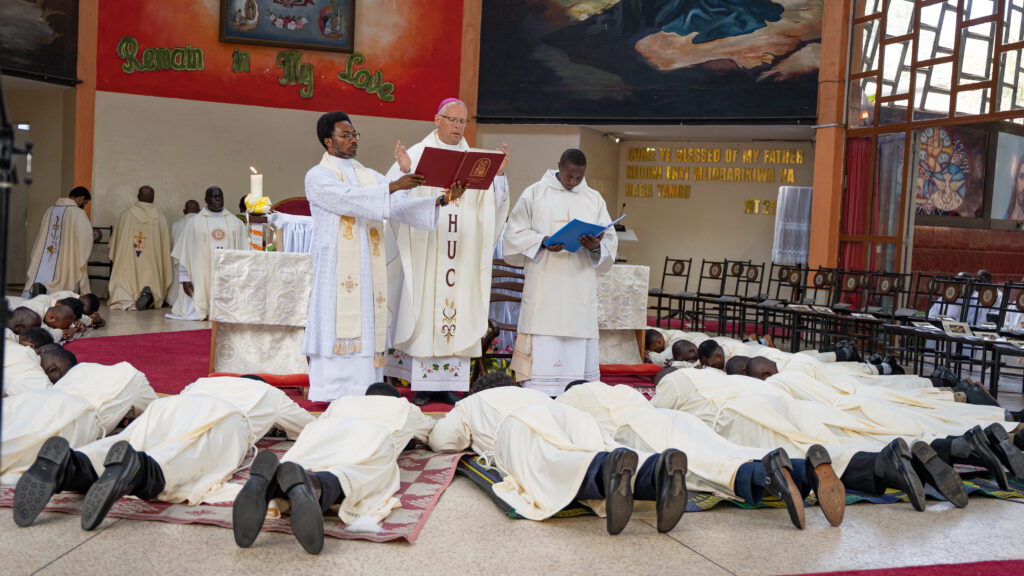
In a stirring homily during the diaconate ordination of Hekima University College students on February 14, 2026, the Apostolic Nuncio to Kenya, His Excellency Archbishop Hubertus van Megen, called on the new deacons to embrace a life of “radical attachment” to Christ while remaining “unworthy servants” to the world.
Speaking at Our Lady of Guadalupe Parish, the Nuncio used the biblical image of the Levites and the missionary journey of St. Philip to define the role of the deacon in the modern Church.
Drawing from the Book of Numbers, the Nuncio explained that the word “Levi” means to be joined or attached. “Just as the Levites had no land inheritance because God was their portion, the deacon’s celibacy and prayer life signify a total dedication to God alone,” he explained adding that a deacon’s life is set-apart, meaning, just as the Levites of the Old Testament had no land inheritance because God was their portion, the deacon’s vow of celibacy is a sign of total dedication to the Lord. He reminded the candidates that their role is fundamentally practical, maintaining the “tabernacle” of the community and serving at the right hand of the priest.
Using the story of Philip and the Ethiopian Eunuch (Acts 8), the Nuncio highlighted the deacon’s unique position, which included a deacon being a mediator where the deacon acts as a bridge between the “sacred” (the altar) and the “profane” (the world). “He is often the one doing the ‘ errands’ between the Church and society.” The deacon being the “Spirit-Led” Servant; “Philip is the model deacon, obedient and swift to follow the Spirit without questioning his career program. He went to the desert route simply because God called,” the Nuncio explained.
In a powerful contemporary reference, the Nuncio spoke of the “Kandakes,” the Nubian queens of Sudan. He compared the ancient Ethiopian eunuch to the courageous young women of the 2019 Sudanese Revolution, noting that the Gospel reaches those who have known humiliation and suffering.
The Archbishop issued a direct challenge to the candidates to avoid the perks of the ministry, in other words, clericalism. He urged them to serve and move on, just like Philip, who, after baptizing the eunuch, vanished.
“You should never lead people to yourself,” the Nuncio warned. “There is no need for applause, no need for the ‘envelope’ (sadaqa). After the work is done, say: ‘We are unworthy servants.'”
He emphasized that the diaconate is about service without expectation, characterized by humility rather than arrogance or privilege. He noted that as members of missionary congregations, the candidates must be “ready to go into the world.” He entrusted their ministry to Our Lady of Guadalupe, the “Heavenly Kandake,” praying that they may always do whatever Christ tells them.
Twenty-Three deacons were ordained during the ceremony, among them fifteen Jesuits, three Carmelites of Mary Immaculate (CMI), and five Augustinians of the Assumptionists (AA).
