
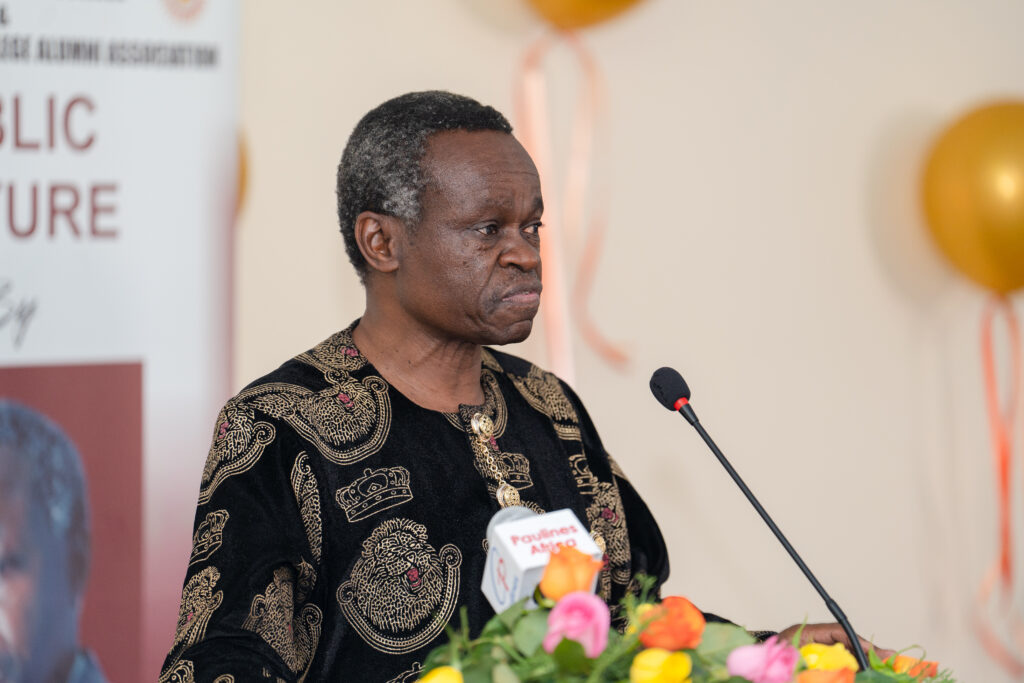
Prof. P.L.O. Lumumba challenges Kenyans to see peace not merely as the absence of conflict, but as a deliberate investment in the nation’s future.
NAIROBI, 11 September 2026 — With Kenya’s 2027 General Elections drawing closer, Hekima University College has opened an important national conversation: how can the country prepare for peace before political temperatures rise, rather than waiting to respond after conflict has already taken hold?
That question brought together diplomats, government and civil society representatives, scholars, peace practitioners, students, alumni and members of the Hekima University College community at the Hekima Institute of Peace Studies and International Relations (HIPSIR) on Friday, 11 September 2026, for a public lecture on “Investing in Peace in the Pre- and Post-2027 General Elections in Kenya.” At the centre of the conversation was renowned Kenyan lawyer, scholar, and public intellectual Prof. P.L.O. Lumumba, whose address offered a sweeping reflection on Kenya’s political history, Africa’s experience of conflict, and, above all, citizens’ responsibility to protect the country from electoral violence.
The significance of the gathering was captured from the outset by the Principal of Hekima University College, Rev. Dr. Marcel Uwineza, SJ, MBA, PhD, who reminded the audience that peace should never become an emergency response that begins only when an election is approaching. “Peace is not what we begin discussing when an election approaches,” Fr. Uwineza said. “Peace is what we must invest in long before the ballot papers are printed.” His words set the tone for an afternoon that would repeatedly return to the idea that peace is built long before the first vote is cast.
The Principal warned that societies often wait until political temperatures have risen, neighbours have begun looking at one another with suspicion and inflammatory language has spread through social media before convening conversations about peace. By then, he argued, the country may already have waited too long. “Words are never innocent,” he observed, noting that words can prepare the ground for violence long before the first stone is thrown, but can also restore dignity, heal memory and call a nation back to its better self. For Hekima, therefore, the conversation was not simply about the 2027 elections; it was about the kind of political culture Kenya is building in the years leading to them.
Against this backdrop, Prof. Lumumba took the podium. After acknowledging Fr. Uwineza, members of the diplomatic community, senior academics and other distinguished guests, he immediately placed Kenya’s preparations for 2027 within the wider and often troubled context of governance and conflict across Africa. He reflected on conflicts and political crises affecting different parts of the continent, including Sudan, the Democratic Republic of Congo, the Central African Republic, Cameroon and countries in the Sahel, using these experiences to challenge the assumption that peace can simply be taken for granted.
For Prof. Lumumba, the absence of open warfare does not necessarily mean that a society is at peace. Drawing on the Portuguese expression nem guerra, nem paz, “no war, no peace,” he described a condition in which a country may appear stable while remaining deeply divided, anxious and vulnerable. Kenya, he observed, has often been described as an “island of peace” in a turbulent region, but he cautioned that this description matters only when the country honestly examines the tensions and unresolved questions beneath its apparent stability.
To understand those tensions, Prof. Lumumba took his audience on a journey through Kenya’s political history. From the country’s early years after independence, he traced the evolution of political competition and the gradual entrenchment of ethnicity in the organisation of political power. He reflected on the one-party era, the attempted coup of 1982, the return to multi-party politics, the ethnic clashes of 1992 and 1997, the constitutional reform process and, ultimately, the devastating post-election violence of 2007–2008. His central argument was that Kenya’s electoral challenges cannot be reduced to what happens on election day. They are rooted in deeper questions of power, accountability, belonging, institutional trust and whether elections are primarily contests between ideas or increasingly contests between ethnic and political formations.
Drawing on his own involvement in Kenya’s constitutional reform process, Prof. Lumumba recalled the extensive consultations across the country, during which citizens raised concerns about centralised power, marginalisation, exclusion, and the need to devolve services and political authority. The 2010 Constitution introduced devolution and established a new institutional framework intended, among other things, to address some of these historical grievances. Yet, as Prof. Lumumba observed, constitutional reform alone cannot resolve a political culture that continues to divide citizens along ethnic lines.
This became one of the central threads of his lecture: Kenya has too often postponed rather than resolved the problems that threaten its national cohesion. Every election, he suggested, exposes unresolved questions about power, accountability and belonging. Political settlements may calm tensions temporarily, but unless the underlying causes are addressed, the country risks carrying the same problems into the next electoral cycle.
His concern sharpened when he turned to the language of contemporary Kenyan politics. Prof. Lumumba challenged the tendency to reduce political competition to calculations of which ethnic combination can assemble enough numbers to secure power. He asked the audience to consider what happens to a country when political debate moves away from questions such as healthcare, education, infrastructure, agriculture and employment and becomes instead a contest over which ethnic or political bloc will control government. “When your agenda is domination,” he warned, “that is a powder keg.”
For Prof. Lumumba, this is not merely a question of political rhetoric. Language can shape how citizens perceive one another, and once communities are portrayed as enemies, outsiders, or less worthy citizens, the distance between political disagreement and physical violence can become dangerously short. He therefore called on Kenyans to pay close attention to the language used by politicians, the media and citizens themselves. “We must change our language,” he urged, expressing particular concern about coded and inflammatory language used in vernacular media and political discourse. Dehumanising language, he argued, can gradually make violence easier to justify, making it important for media practitioners and citizens alike to ask whether what they broadcast, publish and share builds Kenya or divides it.
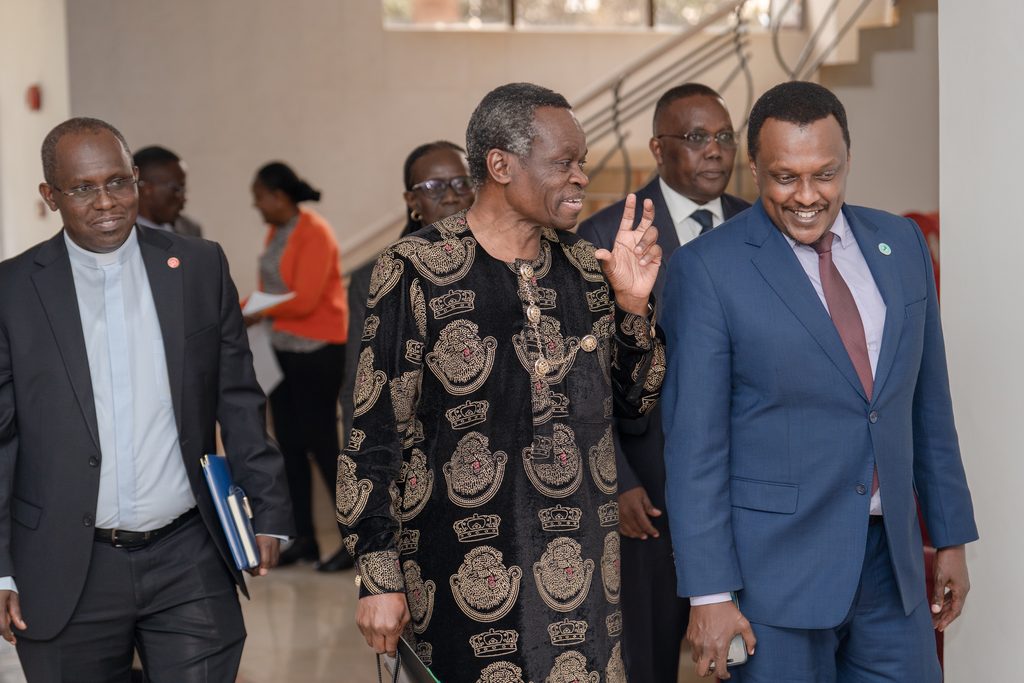
Yet Prof. Lumumba was careful not to place the responsibility for peace entirely on politicians, institutions or the media. Again and again, he brought the conversation back to ordinary citizens. He challenged Kenyans to become active participants in protecting peace, beginning in their own neighbourhoods, schools, churches, mosques, workplaces and communities. He called for structures such as Nyumba Kumi to serve not simply as security mechanisms but also as spaces where neighbours know one another and are able to look out for each other. Invoking the Christian story of the Good Samaritan, he asked a simple but profound question: Who is your neighbour? In a country of many ethnicities, religions and political affiliations, the answer, he suggested, must extend beyond one’s immediate community.
This emphasis on personal responsibility connected strongly with Hekima’s own Jesuit identity and mission. Fr. Uwineza had earlier described Hekima as a place where faith, intellectual inquiry, justice and service converge, and where education should form women and men capable of contributing to the transformation of society. Through its work in peace studies, international relations, migration, security, diplomacy and related fields, and through initiatives undertaken by HIPSIR and the Centre for Research, Training and Publications (CRTP), the College seeks to ensure that knowledge does not remain confined to classrooms and academic publications but contributes to public debate, policy and the prevention of conflict.
Prof. Lumumba, however, challenged the audience to take that responsibility beyond research and discussion. He posed a deeply personal question: What is your contribution to Project Kenya? Young people, in particular, were challenged to move beyond commenting on national affairs through TikTok, Instagram and Facebook and to consider what they can actually do to protect peace. Reflecting on figures such as Mahatma Gandhi, Ali Mazrui and Patrice Lumumba, he used their stories to illustrate the importance of individual action. One person may not be able to solve a national crisis, he suggested, but each person can choose to speak, write, educate, challenge injustice or simply refuse to participate in division. “Sometimes it is only your voice that you can use,” he said, stressing that history may remember that an individual tried.
That sense of personal responsibility was at the heart of his call for Kenyans to “morally re-arm.” For Prof. Lumumba, moral responsibility is not an abstract philosophical idea but something visible in everyday conduct: whether citizens respect the law, whether they treat strangers with dignity, whether they refuse to normalise corruption and whether they are prepared to do what is right even when doing so is inconvenient. He illustrated the point through an ordinary observation from his journey to work that morning, reflecting on the way people drive and obey—or fail to obey—traffic rules. For him, such everyday behaviour can reveal something about a society’s relationship with rules, authority and responsibility.
The point was simple but far-reaching: peace begins long before political campaigns. It is reflected in how citizens treat one another, the language used in homes and churches, on radio stations and social media, and in the choices political leaders and ordinary citizens make every day. It is strengthened when people refuse to allow political competition to turn neighbours into enemies.
Prof. Lumumba also warned against complacency. He asked the audience to imagine what could happen if political tensions were allowed to deteriorate into sustained violence: families displaced, children unable to attend school, businesses abandoned and citizens forced to seek refuge in their own country or elsewhere. Kenya, he reminded the audience, has already experienced the consequences of electoral violence and therefore does not need to wait for another crisis to understand the value of peace.
Preparing for peace, he argued, must therefore involve the Church, universities, civil society, the media, political leaders, community organisations and ordinary citizens. Faith communities, in particular, have a responsibility to speak clearly and consistently for peace. But prayer, he cautioned, must be accompanied by action. “Beyond prayer,” he urged, “wherever you are in your little village, in your little neighbourhood, talk peace.”
His appeal resonated with the broader purpose of the gathering, which also marked the official launch of the National Peace Initiative by the Hekima University College Alumni Association (HUCAA), in collaboration with CRTP and HIPSIR. The initiative is intended to sustain engagement across the HUC community and contribute to broader efforts towards peace and national cohesion as Kenya approaches the 2027 General Elections.
The launch gave practical expression to the message running through the lecture: the conversation must move beyond a single event. Research must connect with action; education must strengthen responsible citizenship; dialogue must challenge prejudice; and early warning must be accompanied by early action. In this sense, the public lecture was not simply an academic engagement but part of a broader effort by the HUC community to remain actively engaged with questions of peace and national cohesion.
The significance of the occasion was also reflected in the breadth of participation. The lecture brought together members of the diplomatic community, including the Ambassador of Rwanda to Kenya, representatives of the High Commission of Mozambique, the Royal Norwegian Embassy, the East African Standby Force and the United Nations system, including representatives working with UNEP and UN-Habitat. Also represented were the Media Council of Kenya, the Catholic Justice and Peace Commission of the Diocese of Ngong and Paulines Publications, which provided live coverage of the event. Government and civil society representatives, academics, peace practitioners, alumni, students and friends of Hekima University College also participated in the gathering.
As Fr. Uwineza reminded the gathering, “2027 must not surprise us. We know it is coming. Therefore, the work of peace must begin now.” Prof. Lumumba’s closing message carried the same urgency. He called upon Kenyans to use their voices, speak against division, defend the dignity of others and recognise that peace is not a responsibility belonging only to government officials, diplomats or peacebuilding organisations. It belongs to everyone.
He reminded the audience that Kenya is a diverse nation, but that diversity need not become a source of division. Drawing on the words of South African anti-apartheid leader Robert Mangaliso Sobukwe, he stressed the common humanity that should bind citizens together: “There is only one Kenya with different ethnicities.”
A vote of thanks was delivered by Rev. Dr. Lado Ludovic, SJ, Dean of HIPSIR and Acting Director of CRTP, bringing the formal proceedings to a close.
But the conversation is not intended to end there. The launch of the National Peace Initiative marks a commitment by the HUC community to continue engaging with questions of peace, national cohesion and responsible citizenship. As Kenya looks towards the 2027 General Elections, the message emerging from Hekima was clear: peace cannot be treated as something to be repaired after violence has occurred. It must be built deliberately, patiently and collectively before it is needed.
The investment, as Prof. Lumumba and Fr. Uwineza reminded the audience, begins with the choices made today—with the words we use, the institutions we strengthen, the injustices we confront, the neighbours we recognise and the responsibility we accept for the kind of Kenya we leave to those who come after us.
Elections will come, and elections will go. Kenya must remain.
By Geoffrey Obatsa – Hekima University College
