
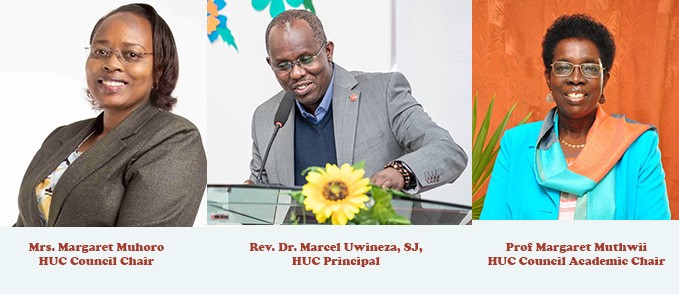

Hekima University College (HUC) on September 3rd, 2026, unveiled a new institutional organogram designed to strengthen governance, clarify responsibilities and reporting relationships, and improve the efficiency of the College as it enters a new phase of growth. The new structure was presented by the HUC Council Chair, Mrs. Margaret Muhoro, and Professor Margaret J. Muthwii, Chair of the Academic Council Committee, during the first meeting for the academic year 2026-2027 of the HUC Management Board, bringing together members of the College’s governance and senior management structures.
Introducing the agenda, the Principal, Rev. Dr. Marcel Uwineza, SJ, described the proposed organogram as part of broader institutional efforts to strengthen HUC’s governance and management structures. He noted that the organogram was not simply an administrative arrangement but part of a larger question concerning the kind of institution Hekima seeks to build for the future.
Aligning structure with strategy
Mrs. Muhoro explained that the new organogram follows the recently developed HUC strategic plan. She emphasized that an effective structure is necessary to ensure that the strategic plan is supported by appropriate people, processes, responsibilities and technologies, while remaining aligned with the regulatory framework governing the institution. “The purpose of the new organisational design is to facilitate efficiency, accountability and the ability to respond to change in HUC’s dynamic institutional environment,” Mrs Muhoro explained, adding that the structure is also expected to influence how resources are used, decisions are made, and the College interacts with its stakeholders.
“The sole responsibility is to facilitate efficiency, facilitate accountability, facilitate change,” Mrs. Muhoro said, emphasizing the need for the organogram to serve as a facilitating rather than a blocking structure. Further expressed that the HUC Council had examined the draft and considered it supportive of the institution’s mission, vision and strategic plan. The presentation was therefore intended to encourage openness, clarification and feedback as the institution worked toward an effective organizational structure.
A structure grounded in governance and regulation
Professor Margaret J. Muthwii, in explaining the philosophy behind the organogram, noted that an institutional organogram is also a requirement under the regulatory framework of the Commission for University Education (CUE). “Beyond fulfilling a regulatory requirement, a well-designed organogram provides a framework for administration and leadership by clarifying how different offices work together and where responsibilities lie.”
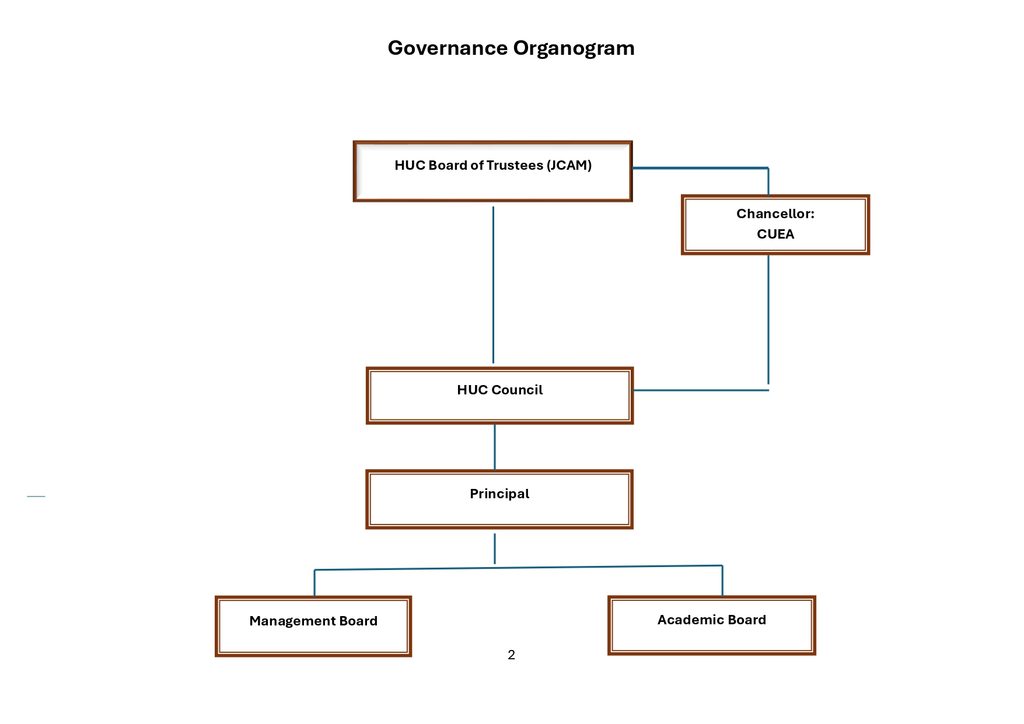
The new HUC structure distinguishes between governance and administration, while recognizing that the two are interconnected. The governance framework includes the HUC Board of Trustees, Chancellor, HUC Council, Principal, Management Board and Academic Board. The HUC Board of Trustees occupies the highest position in the governance structure, while the Chancellor maintains a significant institutional role. The HUC Council serves as a key governance body with responsibilities related to regulatory compliance and supporting the institution in accordance with national requirements.
The Principal, meanwhile, leads the institution and reports directly to the HUC Council, particularly through the Chair of Council. The Management Board and Academic Board have complementary responsibilities, with the Management Board focusing largely on administrative and institutional matters and the Academic Board overseeing academic affairs.
Clarifying leadership and reporting lines
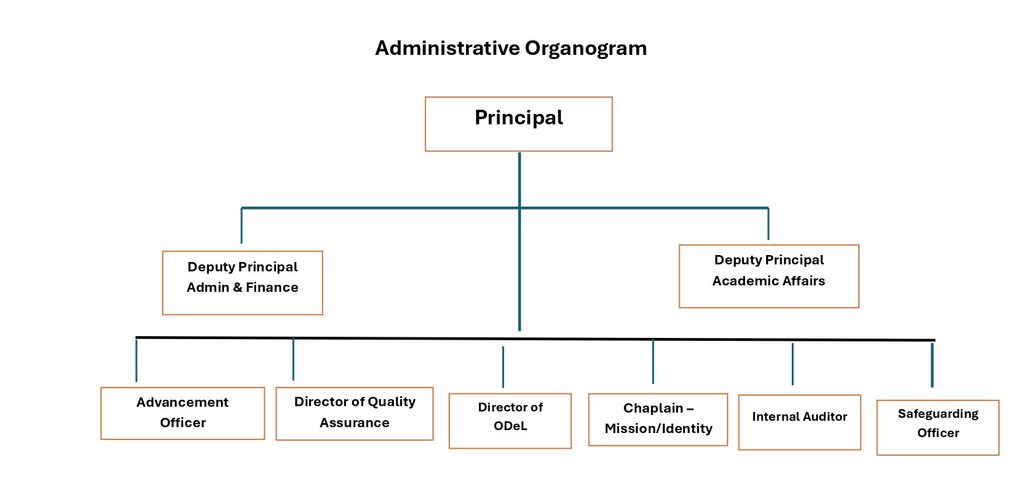
At the administrative level, the Principal is supported directly by two Deputy Principals: the Deputy Principal, Administration and Finance, and the Deputy Principal, Academic Affairs. The structure also places several key offices in direct relationship with the Principal, including the Advancement Office, Quality Assurance, Chaplaincy, Internal Audit, and Safeguarding. These offices play distinct institutional roles while maintaining direct reporting relationships with the Principal.
Professor Muthwii stressed that the structure should not be interpreted simply in terms of hierarchy or rank. Rather, it is intended to ensure that responsibilities are clearly assigned, communication is effective and that different offices do not duplicate responsibilities or leave important functions unattended. “This is organizing how people work so that they don’t step on each other’s toes or nothing falls between the tracks,” she explained.
Strengthening academic leadership
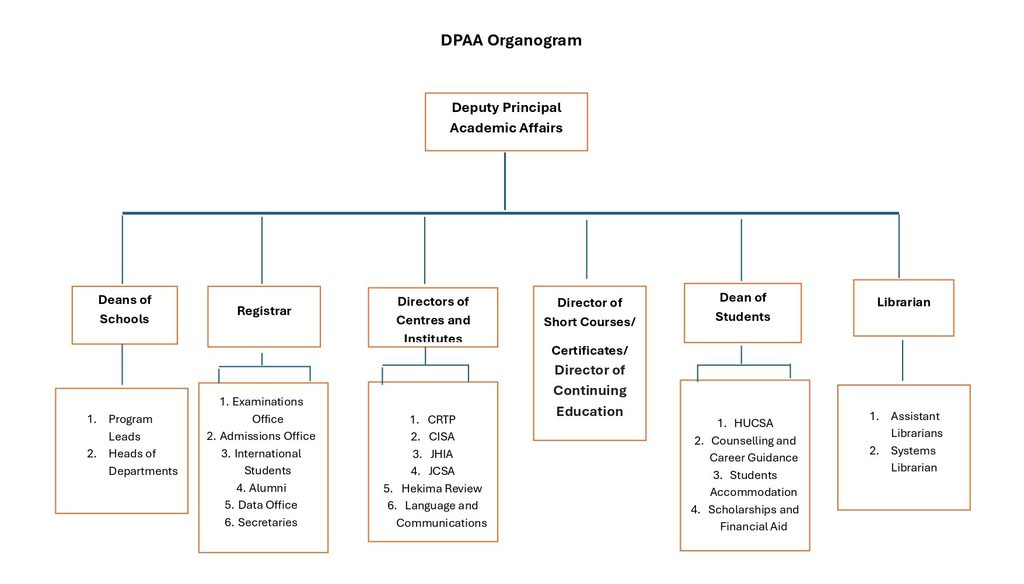
Under the Deputy Principal, Academic Affairs, the organogram brings together key academic offices, including the Deans of Schools, Registrar Academic, Directors of Centers and Institutes, Director of Short Courses, Dean of Students and Librarian. Professor Muthwii described academic affairs as a significant area of responsibility because it encompasses the College’s core academic functions. She also emphasized the importance of collegiality among academic leaders, particularly among Deans, noting that leadership positions are understood as responsibilities exercised during specific seasons of service.
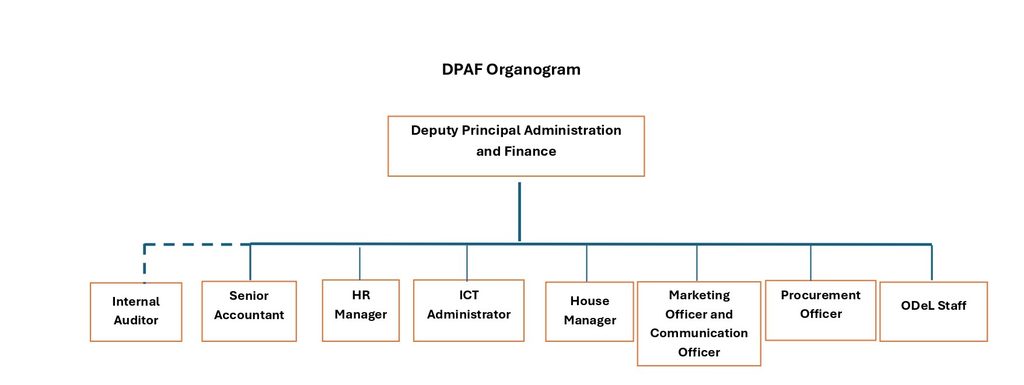
The structure under the Deputy Principal, Administration and Finance includes functions such as procurement, marketing, human resources, accounting, housing and ICT administration. Internal Audit maintains a close working relationship with the administration while retaining a direct reporting line to the head of the institution, reflecting its independence.
Emphasis on HUC’s Christian and Jesuit identity
A distinctive feature highlighted during the presentation was the inclusion of Chaplaincy, Mission and Identity within the institutional structure. Professor Muthwii noted that HUC’s identity as a Christian institution makes these functions particularly significant. The Chaplain therefore maintains a direct relationship with the Principal, reflecting the importance placed on the College’s mission and identity. The organogram also recognizes the role of safeguarding and quality assurance as important institutional functions, alongside advancement and internal audit.
From hierarchy to collaboration
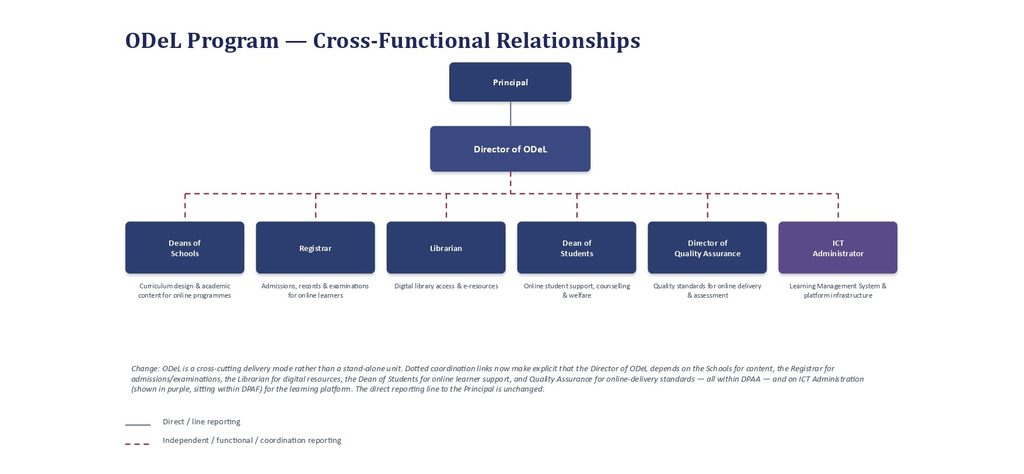
The presentation further highlighted the importance of cross-functional relationships within the new structure. Particular attention was given to Open, Distance and e-Learning (ODeL), which serves the entire institution and therefore depends on collaboration with Schools, instructors, the Library, Dean of Students and Quality Assurance. Professor Muthwii described these relationships as essential to ensuring that different parts of HUC work cohesively rather than operating in isolation.
The Principal similarly cautioned against viewing the organogram merely as a collection of boxes and reporting lines. He stressed that HUC’s success would depend on shared ownership and respect for different offices and responsibilities. “Hekima cannot flourish through isolated experiences… It will flourish through shared ownership,” he said.
Preparing HUC for future growth
The unveiling of the organogram comes as HUC continues to expand its academic programs and institutional activities. The Principal noted that the College is investing in new programs and additional academic and non-academic staff, while recognizing that institutional growth also brings financial and organizational responsibilities. The new structure is intended to provide a framework that supports HUC’s current needs while remaining adaptable as the institution grows. Professor Muthwii noted that some reporting relationships may need review as the College expands.
The Principal placed the organizational changes within a wider vision for HUC, including plans for future institutional development and the proposed Hekima University City Tower, which is envisioned as an integrated environment incorporating learning, research, offices, conferencing, accommodation, hospitality, recreation and other facilities.
Building an institution for the future
In his concluding remarks, Rev. Dr. Uwineza encouraged staff and leaders to view their roles not primarily through the lens of positions and titles, but through their contribution to the long-term development of HUC. He challenged members of the College community to consider what they will leave behind when their responsibilities at Hekima end: whether the institution will be stronger, more united, financially sustainable, academically protected, faithful to its Jesuit mission, and more responsive to its students and colleagues.
The new organogram, he emphasized, is ultimately about enabling people to serve HUC’s mission effectively. It provides a framework for leadership, accountability and collaboration while keeping students at the center of the institution. As HUC continues its institutional transformation, the new organizational structure represents an effort to bring greater clarity to governance and management while fostering collaboration across the College. Its effectiveness will depend not only on the structure itself, but on how the HUC community works together to bring it to life in service of the institution’s mission.By Pamela Adinda, HUC Communications and International Office Coord
