
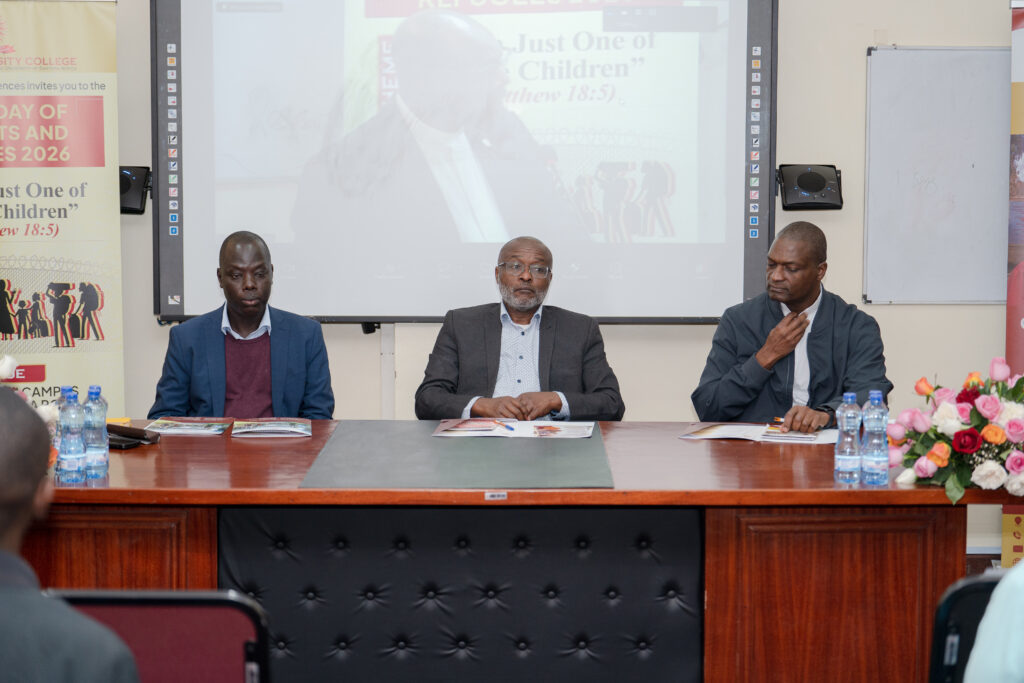
Hekima University College (HUC), through its School of Arts and Sciences, commemorated the World Day of Migrants and Refugees with a conference that brought together Church leaders, academics, students, and practitioners to reflect on the realities migrants and refugees face, particularly children and young people.
Held on Saturday, September 26, at Arrupe Amani Campus on Riara Road, Nairobi, under the theme “Even Just One of These Children,” the event placed the human person at the center of discussions on migration, displacement, humanitarian response, and pastoral care. The conference brought together perspectives from theology, migration and security studies, international relations, and peace studies, while also emphasizing the importance of listening to migrants and refugees themselves.
The event also highlighted HUC’s growing institutional engagement with migration issues. The School of Arts and Sciences has established the Hekima Community Learning Center, which offers the Peace Leader Certificate course to urban refugees, while the College has introduced a new undergraduate programme in Migration, Security and Diplomacy. In his introductory remarks, the Dean of the School of Arts and Sciences, Rev. Prof. Lado Ludovic, SJ, emphasized that the categories “migrant” and “refugee” should never obscure the fundamental humanity of the people behind those labels.
He noted that migration and displacement concern people who, despite their circumstances, retain the same human dignity as everyone else. The purpose of marking the day, he said, was not simply to discuss a social category but to remember people pushed to the margins and reaffirm their dignity.
Protecting migrant children
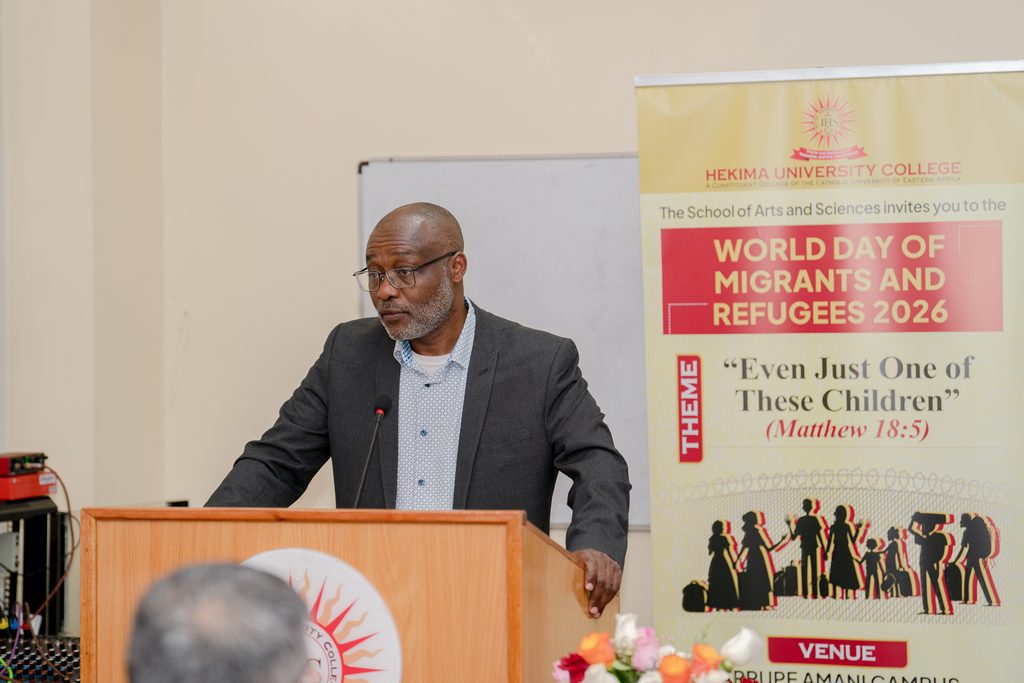
Delivering the keynote address, Mr. Mario Almeida, Regional Coordinator for Africa at the Vatican’s Dicastery for Integral Human Development, focused on the vulnerability of children caught up in migration and forced displacement. Drawing on Pope Leo XIV’s message for the World Day of Migrants and Refugees, Almeida identified three central concerns: the experience of minors involved in migration and flight, the responsibility to care for them, and the Christian conviction that welcoming a child means welcoming Christ. Children on the move, he noted, are exposed to violence, trafficking, exploitation, separation from their families, recruitment into armed groups, sexual violence and other forms of abuse.
Almeida illustrated the human cost of displacement with a personal experience from northern Albania during the Kosovo War, when he encountered an eight-year-old girl who had crossed the border after fleeing violence. He recalled that she refused to remove shoes stained with the blood of her brother, who had been killed in front of her. The experience, he said, remained with him decades later. He stressed that the response to migration must go beyond statistics. Every migrant and refugee, he said, possesses an inherent dignity and fundamental rights that must be protected at personal, ecclesial and institutional levels. Reflecting on the theology and ethics of migration, Almeida described the four verbs articulated by Pope Francis: welcome, protect, promote and integrate, as a guiding framework for the Catholic Church’s pastoral response to migrants and refugees.
He also highlighted the right to remain in one’s homeland, noting that migration is often not a free choice but a consequence of conflict, poverty, climate change, corruption, persecution, lack of decent employment, inadequate education, and other structural conditions. He called for attention to the underlying conditions that compel people, particularly young Africans, to leave their communities. For those who are already on the move, Almeida called for coordinated action involving bishops, clergy, religious and lay leaders, as well as cooperation with other religious communities, governments and civil society organizations. He also emphasized the need for local Churches to advocate for policies that protect the dignity and rights of migrants and refugees.
At the heart of this response, he said, is a Christian understanding of a God who accompanies people in suffering and displacement. Referring to the Holy Family’s flight into Egypt, Almeida presented accompaniment as an essential expression of Christian faith and pastoral mission.
From recipients of charity to co-builders
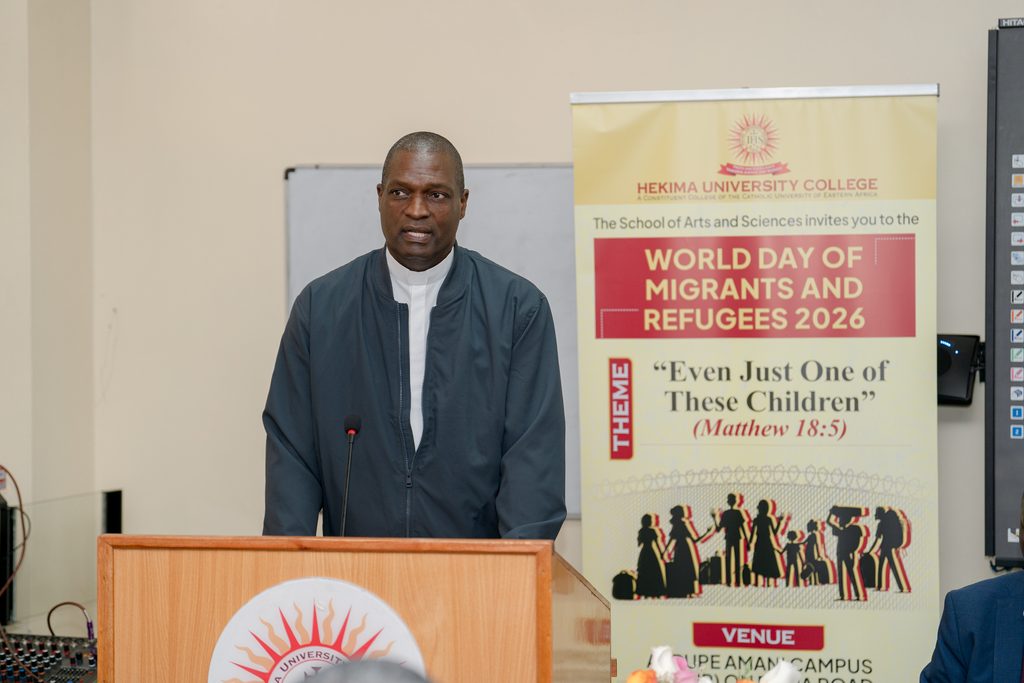
Rev. Fr. Andrew Kaufa, SMM, Secretary General of the Association of Member Episcopal Conferences in Eastern Africa (AMECEA), delivered the second presentation, addressing the theme “Welcoming the Stranger: The Church’s Pastoral Response to Migration and Refugee Realities in the AMECEA Region.” Fr. Kaufa described the scale of displacement in Eastern Africa and emphasized the need for the Church to move beyond viewing migrants and refugees merely as recipients of charity. Instead, he called for them to be recognized as co-builders of the Church and part of the solution. He identified conflict, climate change, hunger, and irregular migration routes as major forces driving displacement across the AMECEA region. He also stressed that behind migration statistics are human beings with identities, histories and equal dignity.
The Montfort Missionary, who is an alumnus of Hekima, outlined various responses being undertaken by Catholic institutions across the region. These include peacebuilding and trauma support in South Sudan; assistance to returnees and internally displaced persons in Ethiopia; legal aid, psychosocial support, and advocacy for integration in Kenya; livelihood, education, and health initiatives in Uganda; vocational training and microenterprise support in Zambia; and medical, psychosocial, and pastoral care in Malawi.
He observed that these experiences give the different Episcopal Conferences opportunities to learn from one another. While their contexts differ, the common objectives include welcoming migrants, protecting them, promoting their wellbeing and supporting their integration into society. Fr. Kaufa identified several challenges limiting the Church’s response, including reduced donor support, difficulties in integrating refugees, irregular migration, inadequate attention to mental health, xenophobia and weak coordination among Church organizations. He consequently called for stronger collaboration, advocacy for the rights and dignity of migrants and refugees, greater attention to children and youth, peacebuilding, safeguarding, and action on xenophobia and climate-related displacement.
Beyond seeing refugees as passive victims
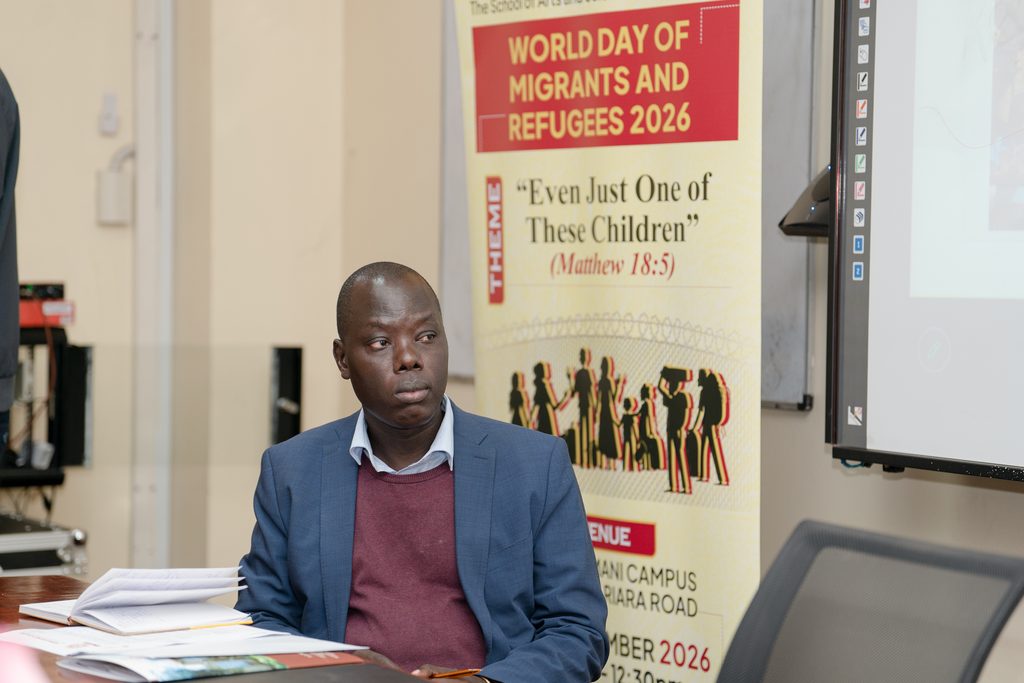
Providing an academic perspective, Dr. Christopher Omollo, lecturer at HUC’s School of Arts and Sciences, examined contemporary migration through the lens of humanitarian governance, human dignity and agency. Dr. Omollo noted that 2026 marks 75 years since the adoption of the UN Refugee Convention and the establishment of UNHCR. He acknowledged the contribution of the international refugee protection system and humanitarian organizations while questioning whether contemporary humanitarian structures always succeed in preserving the dignity and agency of the people they are intended to assist.
Drawing on the work of scholars including Michael Barnett, Gerald Dworkin and Barbara Harrell-Bond, Omollo examined what he described as the risks of paternalism and dependency within humanitarian systems. He argued that refugees can sometimes be reduced to passive recipients of assistance rather than recognized as people with skills, professional identities, knowledge and the capacity to shape their own futures.
He further raised questions about the increasing collection of refugees’ personal and biometric data as a condition for accessing services, arguing that humanitarian systems must pay greater attention to consent, privacy, autonomy and dignity. He also questioned the continued use of short-term emergency structures to manage displacement situations that can last for decades. Turning to Kenya, Omollo reflected on the long-standing experience of refugee encampment in Dadaab and Kakuma, arguing that prolonged restrictions on movement and access to formal employment can contribute to structural dependency.
He highlighted the importance of approaches that recognize refugees as active participants in their own lives. These include refugee-led organizations, employment opportunities that allow displaced people to recover their professional identities, and forms of assistance that give families greater control over household decisions.
A significant theme emerging from Omollo’s presentation was the concept of accompaniment, particularly as practiced by the Jesuit Refugee Service (JRS). Rather than creating a relationship between an expert and a passive recipient, accompaniment seeks to walk alongside the displaced person. For Omollo, this approach resonates deeply with Christian theology: migrants and refugees are not simply administrative cases to be managed but persons whose dignity demands presence, relationship and solidarity. He also pointed to emerging efforts in Kenya to move beyond traditional refugee camps toward more integrated settlements, while emphasizing that such transitions need to be accompanied by attention to legal status, freedom of movement, economic participation and human dignity.
Across the three presentations, a common message emerged: migration cannot be adequately understood through statistics alone. The speakers drew attention to the particular vulnerability of children, the structural causes of forced migration, the pastoral responsibilities of the Church, and the need to recognize migrants and refugees as people with agency and capacity rather than simply as beneficiaries of humanitarian assistance.
The discussions also reinforced the need for collaboration among Churches, governments, humanitarian organizations, academic institutions and civil society. For HUC, the conversation reflects the College’s expanding engagement with migration through academic programmes, research, formation and community initiatives.
As the conference brought together theology, pastoral practice, and academic analysis, it gave the Hekima community an opportunity to consider how institutions can contribute to a response to migration that protects human dignity while enabling migrants and refugees to participate meaningfully in the societies in which they live. The celebration ultimately placed a human face on the realities of displacement: behind every statistic is a person, and behind every category is a human being whose dignity remains intact.
By Pamela Adinda, HUC Communications & International Office Coordinator
