

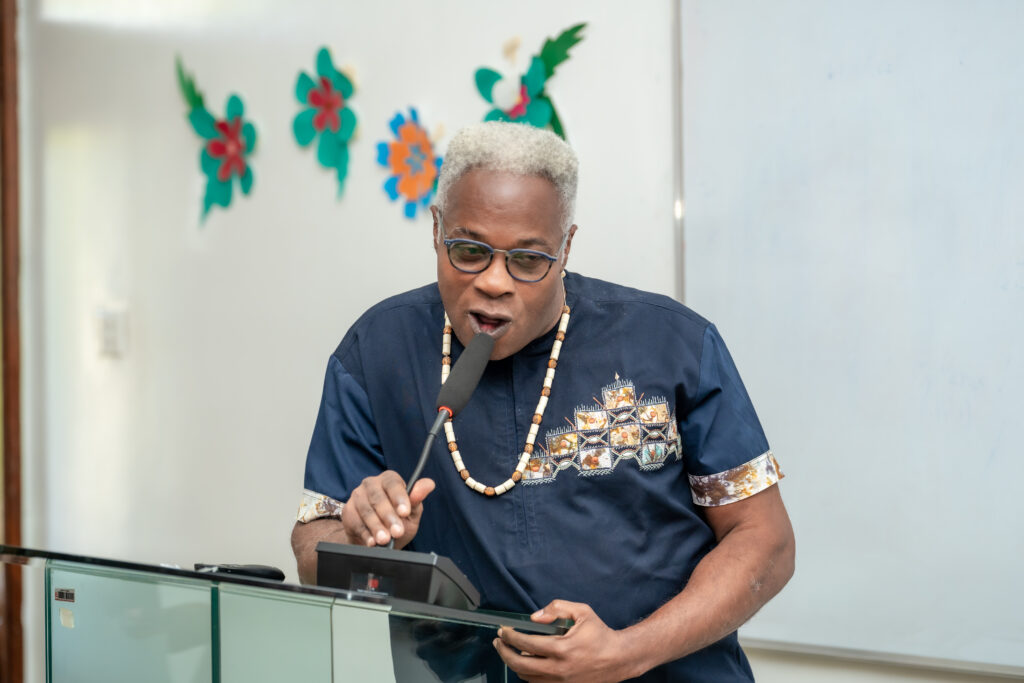
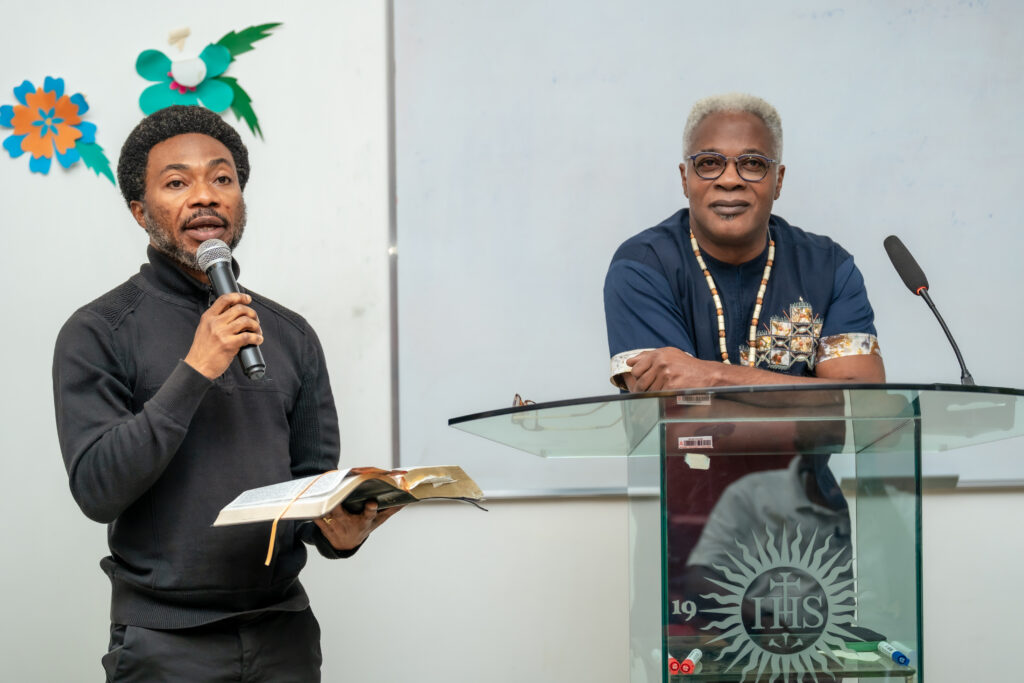
Following Professor James Jay Carney’s public lecture at Hekima University College, Rev. Dr. Wilfried Okambawa, SJ, a distinguished New Testament scholar from ITCJ (Abidjan), provided a profound biblical response titled “Ekuabo/Akwaba Hermeneutics of the Prodigal Son.”
Delivering his remarks as a “biblical scholar who cannot talk outside of the New Testament,” Prof. Okambawa utilized the famous Lukan parable to explore the boundaries of culture, grace, and what he termed “social and cultural death.”
Prof. Okambawa’s response centered on the argument that both the New Testament and African Traditional Religions (ATR) share a foundational pillar: the dialectic of life and death. He noted that in many African initiation ceremonies, a young man must “die” in the bush to return with a new personality and name.
He applied this lens to the Prodigal Son, identifying three distinct types of death present in the text, namely Psychosocial Death, represented by the younger son’s departure from his father’s house, Cultural Death, represented by the son’s exile where, as a Jew, he was reduced to the “zombie life” of feeding swine, and the Physical/Biological Death, represented by the looming threat of perishing from hunger.
In a direct dialogue with Carney’s warnings about domesticating the Gospel, Okambawa argued that the heart of the parable is actually counter-cultural.
“In my culture,” Okambawa noted, “if a father sees a son who squandered his inheritance returning, the first step is punishment.” Instead, the parable depicts an old man running, an act Okambawa described as “not normal” for a patriarch, to embrace a sinner. This, he argued, marks the shift from the “logic of merit” found in culture to the “logic of supernatural grace.”
The scholar tied the story’s theological climax to the Akan word Akwaba (or Ekuabo). He explained that the term literally implies: “You are gone (dead), and you are back (resurrected).” “When the father says, ‘This is my son who was dead and is alive again,’ he is expressing the ultimate Akwaba,” Okambawa stated. He argued that the younger son only discovered the “real face of the father” after experiencing the “bad life” of cultural and social death.
Professor Okambawa concluded with a warning regarding the elder son, whom he described as living a “bad life” of “discontent.”
“He was apparently a good son, but he lived as a slave in his father’s house,” Okambawa observed. By refusing to enter the feast, the elder son remained “outside of life,” trapped by a rigid adherence to law and merit that prevented him from participating in the “supernatural forgiveness” that transcends culture.
His final reflection challenged the audience to move “beyond culture and whiteness” to a Christianity in which life is viewed not as a miracle to be expected but as a gift of grace to be received through the death of the self.
By Pamela Adinda, HUC Communications & International Office Coordinator
